Cato–Sydea relationship
Systema Delenda EstCato–Sydea relationship is one of liberation, intervention, and reconstruction. Cato does not merely defeat Sydea’s ruling System; he removes the conditions that made System life the planet’s only apparent reality, then remains involved long enough to address the consequences. The relationship therefore resists a simple hero-and-rescued-world pattern. Sydea becomes free because of Cato, but freedom initially arrives as another planetary catastrophe, demanding industrial, ecological, and social repair.
A Liberation Born from Catastrophe
The relationship begins within the larger disaster caused by the System’s arrival. On Earth, technology failed, monsters appeared, and billions died as humanity was forced into the game-like physics imposed by the System. Sydea embodies the same structure of domination in another world: survival is organized around System towns, dungeons, conflict zones, essence, quests, and the whims of godlings. Cato’s opposition is consequently not a territorial dispute with Sydea or its inhabitants. His quarrel is with the System itself, and Sydea becomes the first major world where that opposition is converted into a practical program of emancipation.
Cato’s methods reveal the asymmetry between his technological civilization and Sydea’s System-bound society. The System suppresses advanced machinery, but Cato’s warframe and associated organisms exploit the narrow category of what can count as organic. His body contains cells and organs functioning more like industrial machinery than natural biology, while a System interface is isolated in the warframe’s crown so the System can integrate only a deliberately exposed component. This arrangement lets him act inside Sydea without accepting its assumptions. Even the System map, a thin sheet between metal and glass that falls apart without System support, becomes an instrument Cato can translate into memory and use to identify cities, dungeons, conflict zones, resources, and the mountain he seeks.
The decisive break is violent. After an antimatter detonation destroys the meeting site and kills everyone there, Cato transmits that the Bismuth is dead and orders Raine and Leese to escape through the portal. His surviving orbital infrastructure begins sending hundreds of satellites into de-orbit, turning the victory into the opening move of a broader contingency. The destruction of the planetary and city anchors follows. Once the System Interface has been extracted from the gem in Onswa’s office sufficiently for Cato to proceed, he destroys the city anchor and begins dismantling the support structure that has shaped Sydea’s existence.
The System’s Withdrawal from Sydea
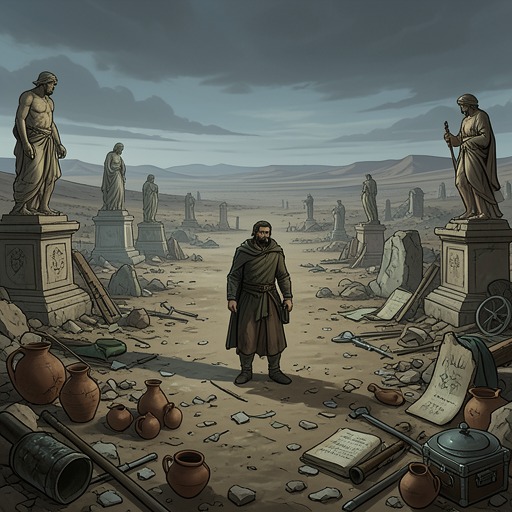
The collapse is not clean or symbolic. When the planetary Nexus is removed, every other town appears to lose power, or more precisely, essence. Lights go out, stores shut down, and the System retreats from spaces Cato had not realized depended upon it. Mountains crumble or vanish, broad lakes become muddy plains, and sudden storms announce the instability of a planet whose physical conditions had been partly maintained by an artificial order.
The landscape undergoes a form of accelerated ecological succession. Grasslands shift toward native life, alien forests wither, and transplanted organisms die rather than simply disappearing into System-stuff. The resulting scars will remain for years or decades despite the biological factories Cato has prepared. The contrast is central to the Cato–Sydea relationship: the end of oppression does not restore an untouched past. Liberation exposes damage accumulated under the System and converts political freedom into a problem of planetary engineering.
Raine and Leese witness the transformation from both satellite and local perspectives. A single color change on a planetary display corresponds to the replacement of everything a warframe can see below, including the disappearance of invasive monsters. Leese recognizes the scale of the event as terrifying, while Cato explains that this is what the System does and that undoing the damage will take years. His promise that Sydea will have its planet to itself again is therefore neither a claim of immediate restoration nor a denial of suffering; it is a commitment to a future whose conditions must still be built.
The final dungeon is a Platinum-ranked site occupied by massive burrowing metal wyrms. Cato’s four warframes reach its core, crush it, and withdraw before the quarry where the dungeon stood wavers and vanishes. The transparent portals in Sydea’s two major cities then shrink, flicker, and disappear together. With the dungeon and portals gone, the System’s spatial and social architecture is no longer merely weakened. Sydea is cut off from the mechanism that had made System existence universal.
Freedom as a Material Obligation
The immediate human consequence is described in physical terms. People can walk outside city walls without being attacked for the first time. They can look into the sky without fearing winged monsters. Children born under the System are no longer restricted to combat and the whims of godlings. Sydea becomes bound to ordinary physics, making possible genuine civilization, art, architecture, philosophy, science, and eventual expansion to the stars. Cato’s liberation changes the range of lives that Sydeans can imagine, not simply the authority that governs them.
Yet Cato understands that removing the System without preparation would be another apocalypse. Machinery produces replacement infrastructure for System towns, and re-entry vehicles gather in orbit while he prepares to support the population through the transition. Sydea’s low population makes the undertaking possible: a single moderately large city could have housed everyone on the planet. That demographic fact allows Cato to deploy resources at a scale that would have been much harder on a crowded world, but it also underscores how thoroughly the System has failed to sustain a flourishing society.
Cato escorts groups out of dungeons where scattered communities have continued fighting monsters merely to obtain enough food to live. He does not claim that all conflict can or should disappear. His intervention instead targets the System’s conversion of combat into the only available way of life and the only available reality. The distinction matters: he is not promising a world without danger, but a world in which danger no longer monopolizes existence.
The relationship also includes a refusal of conventional conquest. Cato gives Sydea its orbital infrastructure and shows no interest in personally ruling the planet. That decision leaves political authority to former Platinums and makes liberation a transfer of capacity rather than a change of imperial owner. Onswa possesses planetary eyes and ears and the force to act on what he learns; Arene controls the remaining orbital railguns and supervises the industrial fires as factories rise beyond the cities; Hirau and Marek lead the repair of the land and sea. Cato supplies tools, weapons, machines, and knowledge, but Sydeans must learn to use them and govern the consequences.
Reconstruction and the Cost of the New World
The division of labor gives Sydea’s freedom a social form. Karsa takes responsibility for constructing and rebuilding cities and establishing education. Her teaching concerns basic but foundational practices: cleanliness, writing, and cooking. The variety of food available after the System is gone becomes a small but telling sign of expanded life, because nourishment is no longer limited to what the System can provide.
The restoration remains far from complete. Cato’s later campaigns make clear that the pattern first seen on Sydea recurs elsewhere, but Sydea remains the model through which he confronts the ecological and political cost of System severance. When he plans the crash of the System on Haekos, he anticipates total ecosystem collapse, including the microorganisms responsible for producing oxygen. He worries about oceans and altered coasts, and he recognizes that the first world to undergo the transition has been unlucky. Sydea thus becomes both precedent and warning: its experience teaches Cato that the System’s disappearance must be followed by remediation, not simply celebrated as victory.
Cato’s relationship with Sydea also exposes the limits of technological rescue. The planet lies thousands of light-years from Sol, and communication with his home star will take an extraordinarily long time. Cato cannot wait for messages from other versions of himself elsewhere in the System, nor can he guarantee that those versions survived. Sydea’s future therefore unfolds beyond immediate supervision. The world has been freed, but the liberator cannot remain an omnipresent guardian; the political and ecological work must pass to the people and institutions developing on the planet.
Narrative Significance
Sydea is the clearest demonstration that Cato’s anti-System project is not equivalent to destruction for its own sake. The System’s collapse causes mountains to vanish, lakes to drain into mud, alien forests to die, and communities to lose the infrastructure on which they depended. Cato nevertheless treats the collapse as necessary because the System has reduced choice itself: under its rule, combat and divine whim are not merely common conditions but the only recognized reality. His task is to replace that closed world with one capable of sustaining alternatives.
The relationship’s central irony is that Cato must use overwhelming force to create the possibility of ordinary life. Antimatter, orbital satellites, warframes, extracted interfaces, destroyed anchors, and dungeon cores are the instruments of a project whose desired outcome is not permanent militarization but the ability to walk outside safely, educate children, cultivate food, and build cities. Sydea is therefore both the first liberated world and the first proof that liberation carries obligations. Cato removes the System, but the lasting measure of his relationship with Sydea lies in what follows: whether a damaged planet can become a self-directed civilization rather than merely a world that survived its rescuer.